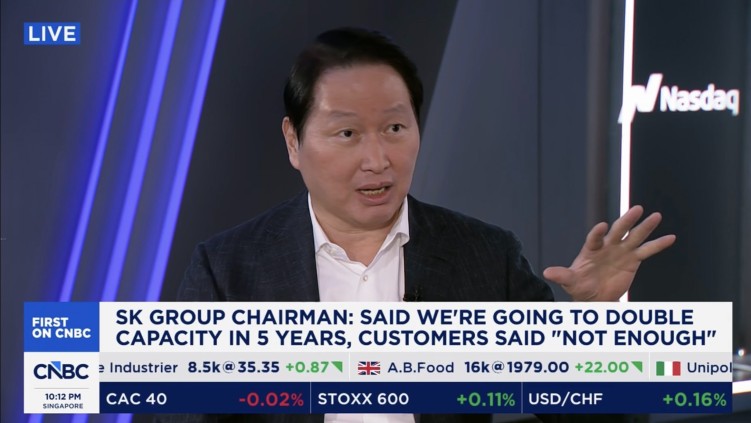
SK Group is the parent company of SK Hynix, the second largest producer of High Bandwidth Memory (HBM) and along with Samsung and Micron Technology, these three company’s control 90% of the market.
The cutting-edge graphics processing units (GPUs) filling data centers around the world require an immense, unrelenting pipeline of data delivered at lightning speed. This is where dynamic random-access memory (DRAM) and high-speed data storage (NAND flash) and the premium architecture of HBM becomes essential.
HBM technology has transformed memory from a historically volatile commodity into the ultimate tech-sector cash cow that has delivered unprecedented earnings growth and share price appreciation over the past year.
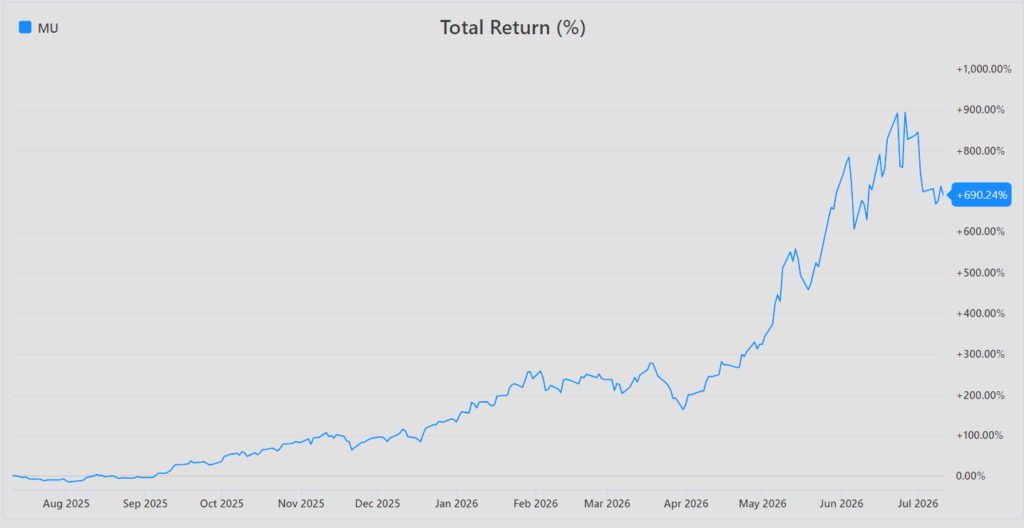
Micron share price over past 12-months
Despite their oligopoly and control of almost 90% of the HBM market, their structural frameworks, financial health, and strategic positioning could not be more distinct. Navigating the memory investment landscape requires understanding how these three players leverage their balance sheets, deploy capital, and align themselves across a fracturing global geopolitical landscape.
SK Hynix stands as the undisputed pioneer and incumbent leader of the HBM universe. Founded in 1983 as Hyundai Electronics, the South Korean manufacturer narrowly escaped collapse under a mountain of debt in the early 2000s. Its 2012 acquisition by the SK Group conglomerate re-established the company as a pure-play memory powerhouse.
Unlike diversified electronics giants, SK Hynix funnels its energy almost exclusively into silicon memory architectures. This single-minded focus allowed the company to outmaneuver its larger rivals by securing a deeply entrenched, early-mover partnership with Nvidia. It was the first to mass-produce advanced HBM3E nodes and has already captured a dominant position for next-generation HBM4 setups.
This specialized focus reflects directly in the company’s financials. Controlling an estimated 62% of the global HBM market as of mid-2025, while maintaining a 32% share in conventional DRAM, SK Hynix has generated record-breaking profitability.Its income statement shows revenues surging into the ₩40 trillion to ₩50 trillion range, yielding an operating margin of 25% to 30% and a net income between ₩8 trillion and ₩12 trillion.
While its ₩120 trillion to ₩150 trillion balance sheet carries a debt-to-equity ratio of 0.5 to 0.7, explosive high-margin HBM shipments are rapidly accumulating cash and driving return on equity into the high-teens to low-20% range.
Despite these stellar metrics, its primary listing on the South Korean exchange leaves it exposed to a persistent regional valuation discount relative to its Western counterpart. This is soon to change, with a planned listing of the company on the Nasdaq on July 10th, 2026. Enabling North American investors to more easily add SK Hynix to their portfolios.
The aggressive challenger to SK Hynix’s dominance is Micron Technology. Based in the United States and listed on the NASDAQ, Micron commands roughly 22% of the standard DRAM market and roughly 21% of global HBM supply.
Rather than climbing through every intermediate development phase, Micron executed a high-stakes engineering leapfrog, bypassing early iterations to launch an ultra-efficient 24-gigabyte HBM3E node. This architecture leverages superior power efficiency as a core selling point to pull design wins away from SK Hynix.
Financially, Micron presents the cleanest and most conservative balance sheet metricsamong the three pure memory businesses. With total assets near $83 billion against a lean $15 billion in total debt, Micron boasts a highly liquid current ratio of 2.5 and a debt-to-equity ratio of just 0.27. This fiscal health supports revenue of $37.4 billion, a 40% gross margin, and a net margin of 23%.
Access to deep Western capital markets allows Micron to trade at a premium forward price-to-earnings multiple relative to SK Hynix. Even as it maintains a massive $20 billion capital expenditure roadmap to transition factories to its native 1-gamma scaling nodes.
Samsung Electronics approaches this battle from a position of sheer scale. As a colossal, diversified conglomerate, Samsung is the volume leader in conventional DRAM with a 36% market share.However, it stumbled during initial validation cycles for its advanced HBM3E components, holding just a 17% slice of the specialized AI memory market.
Samsung is now leveraging its massive capital footprint to mount an aggressive counter-offensive. Its ultimate weapon is an end-to-end, turnkey capability. By combining its leading semiconductor foundry, memory development, and advanced packaging divisions under one corporate roof, Samsung aims to dominate custom HBM4 architectures where memory logic is integrated directly onto foundry processor dies.
Samsung’s balance sheet is a financial fortress.Total assets hover between ₩670 trillion and ₩700 trillion, backed by more than ₩400 trillion in equity and a debt-to-equity ratio of 0.3 to 0.4. This financial buffer allows its total revenue to reach the mid-₩300 trillion range, with net income landing between ₩45 trillion and ₩55 trillion.
While its diversified structure absorbs the cyclical shocks of the memory market, its reliance on consumer smartphones, legacy displays, and underperforming logic foundries keeps its aggregate net margins at 12% to 16% and holds return on equity to the low-to-mid teens.
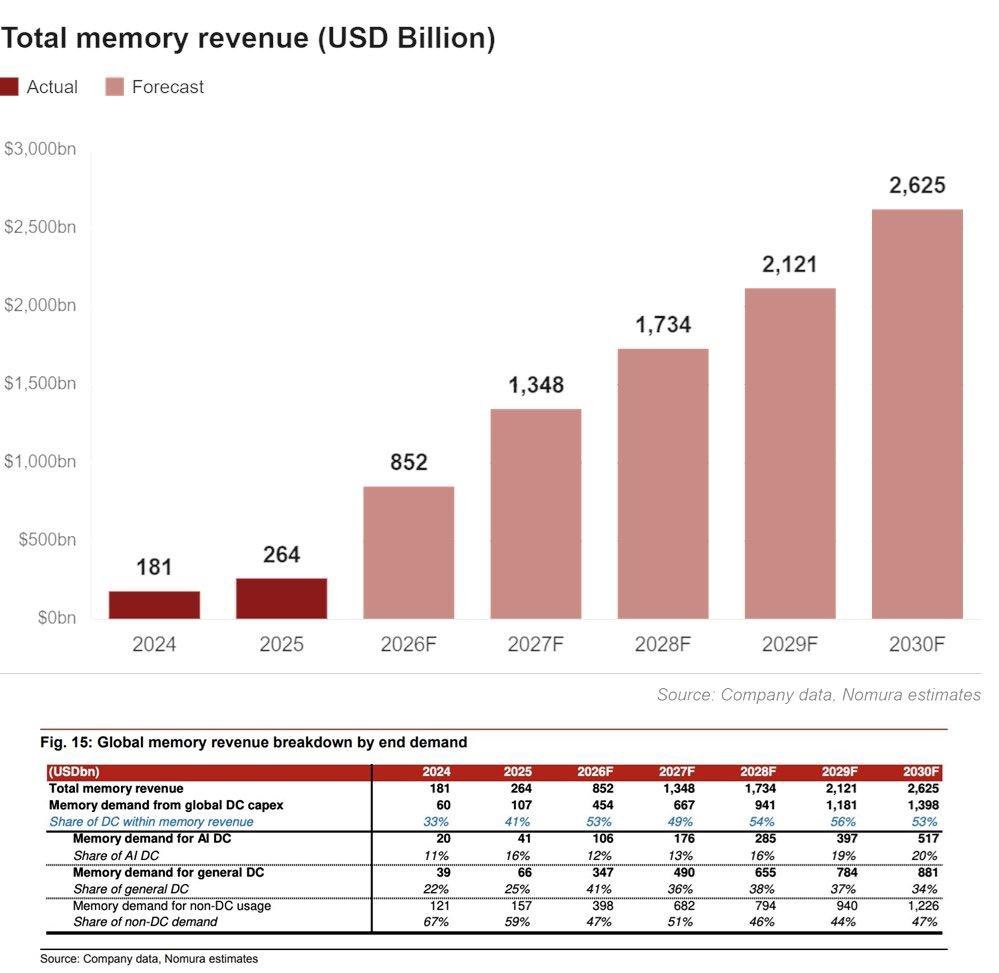
Source: Nomura Securities
Beyond specialized AI chips, all three players are locked in a relentless structural race to shrink standard architectures and drive down the cost-per-gigabyte. In standard DRAM, this means shifting production to sub-10-nanometer 1-beta and 1-gamma layouts. Micron currently holds a slim operational edge in native density by packing cells tightly without immediate reliance on highly complex Extreme Ultraviolet (EUV) lithography systems.
Conversely, both Samsung and SK Hynix have fully integrated EUV machinery into their lines to guarantee long-term structural scaling. In the NAND flash and solid-state storage sectors, dominance is measured by vertical layer count. All three manufacturers are now outputting advanced enterprise solid-state drives featuring triple-stack and double-stack designs that exceed 200 to 300 vertical layers to satisfy the capacity requirements of hyperscale data centers.
This technological arms race is heavily constrained by shifting geopolitical realities. Supply chain resilience has fundamentally reshaped where these companies spend their cash. As the sole domestic US memory champion, Micron sits at the center of Washington’s industrial strategy.
Fueled by multi-billion dollar federal subsidies, Micron is constructing massive manufacturing installations in New York and Idaho. This localized footprint grants Micron a structural compliance and de-risking edge among Western cloud operators looking to insulate their hardware pipelines from Asian supply chains.
Meanwhile, Samsung and SK Hynix form the industrial foundation of South Korea’s massive Semiconductor Mega Cluster project with the recent announcement of an $880 billion investment program over the next ten years. Their challenge is diplomatic and regulatory rather than geographic.
Both companies maintain extensive legacy manufacturing facilities in China, requiring a delicate, ongoing balancing act to comply with strict Western export controls on advanced semiconductor machinery without disrupting their operational baselines.
For investors, the memory triopoly presents three distinct investment profiles:
Samsung offers a highly capitalized, diversified defensive anchor with massive financial resources but lower pure-play memory upside.
Micronprovides a premium-valued, liquid US tech stock with fortress-like balance sheet metrics and a clear domestic regulatory tailwind.
SK Hynix represents the high-beta, hyper-cyclical pure play: currently the most valuation-attractive option on a pure earnings basis, boasting unparalleled near-term HBM leadership and soaring efficiency metrics.
As AI continues to dictate the terms of global computing demand, tracking how these three titans allocate capital across nodes, fabs, and borders will remain a vital indicator for AI portfolios.
DISCLAIMER: This article is for informational purposes only. Not investment or financial advice. Investing involves risk.